Abstract
Generating realistic human-object interaction (HOI) animations remains challenging because it requires jointly modeling dynamic human actions and diverse object geometries. Prior diffusion-based approaches often rely on handcrafted contact priors or human-imposed kinematic constraints to improve contact quality. We propose a data-driven alternative in which guidance emerges from the denoising pace itself, reducing dependence on manually designed priors. Building on diffusion forcing, we factor the representation into modality-specific components and assign individualized noise levels with asynchronous denoising schedules. In this paradigm, cleaner components guide noisier ones through cross-attention, yielding guidance without auxiliary classifiers. We find that this data-driven guidance is inherently contact-aware, and can be further enhanced when training is augmented with a broad spectrum of synthetic object geometries, encouraging invariance of contact semantics to geometric diversity. Extensive experiments show that pace-induced guidance more effectively mirrors the benefits of contact priors than conventional classifier-free guidance, while achieving higher contact fidelity, more realistic HOI generation, and stronger generalization to unseen objects and tasks.
Approach Overview
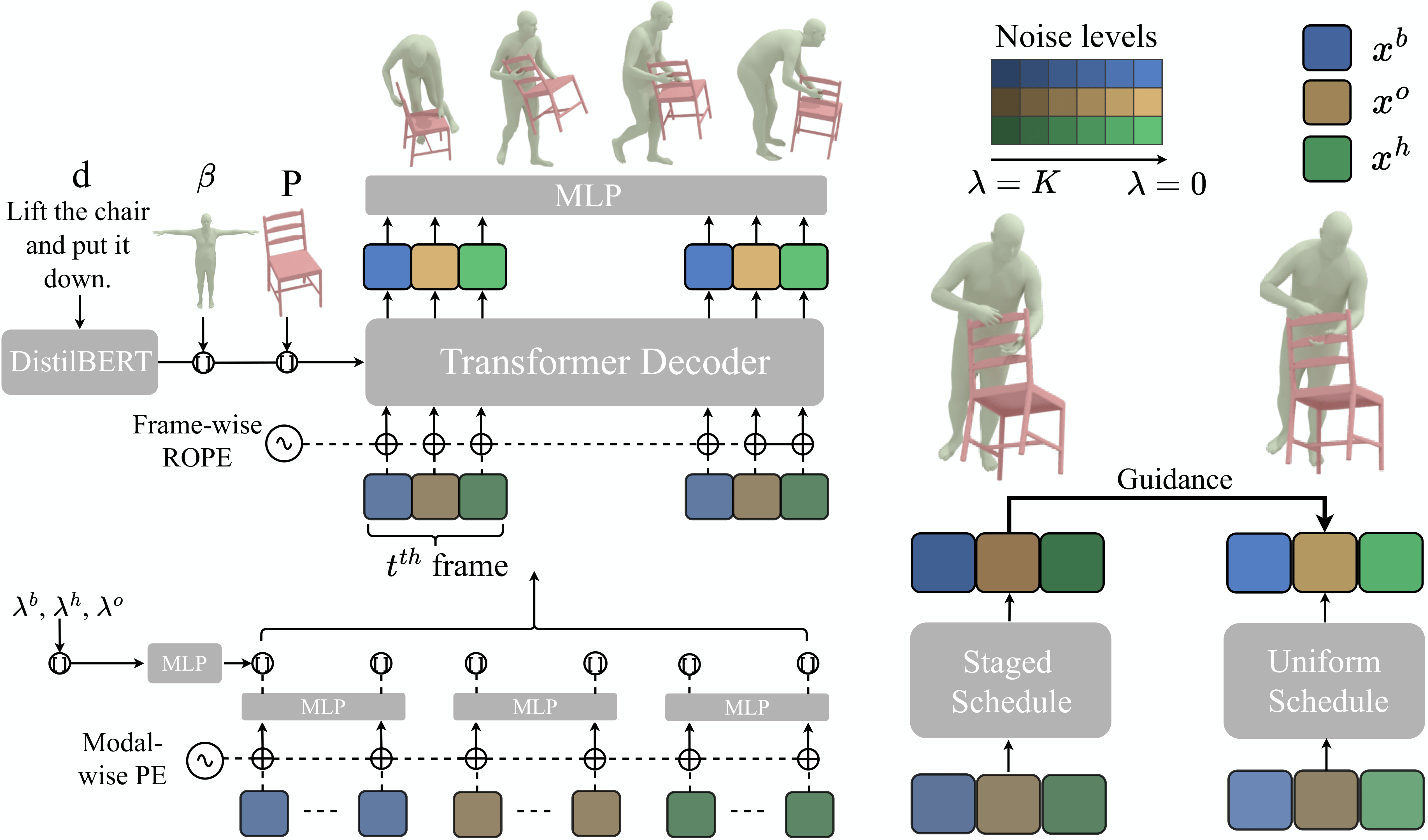
Overview of LIGHT. Left: Training. We form different modalities, e.g., body, hand, and object, each diffused with its own noise level. Right: Inference. We compare a uniform schedule that denoises all modalities synchronously with a staged schedule that keeps one modality cleaner from the uniform run.
Gallery of Generation
A person crosses and uncrosses their left leg over their right while seated.
A person turns their body clockwise, crosses their right leg to a different side of a square table from their left leg, sticks both hands to the edge of the square school table behind their body, and tilts back.
An individual reclines on a yoga ball, extends both legs, and then rises to a standing position.
A person takes a backpack off their left shoulder, puts it on their right shoulder, and walks counterclockwise for a circle.
A person walks forward, grabs and inspects a large torus, then replaces it and returns to their starting point.
An individual grasps a dumbbell with their left hand while extending both legs forward and backward, while rotating their torso to the right.
A person cooks with a pan, switches hands, and adds seasonings.
A person swings a baseball between their hands while walking clockwise, then rubs it in their hands while walking counterclockwise.
Ablation on the Augmentation
A person with a backpack on their left shoulder stretches their right arm backward, then bends down to touch their right foot with their right hand, and then stands back up.
w/o augmentation
w/ augmentation
A person holds a medium box and walks counterclockwise, then carries the medium box while taking small steps in place.
w/o augmentation
w/ augmentation
Ablation on the Guidance
Push the largetable, release the hands, then drag the largetable, and set it back down.
w/o guidance
w/ guidance
Hold the whitechair and turn it around to face a diffferent orientation.
w/o guidance
w/ guidance
BibTeX
@inproceedings{wang2026unleashing,
      title = {Unleashing Guidance Without Classifiers for Human-Object Interaction Animation},
      author = {Wang, Ziyin and Xu, Sirui and Guo, Chuan and Zhou, Bing and Gong, Jiangshan and Wang, Jian and Wang, Yu-Xiong and Gui, Liang-Yan},
      booktitle = {ICLR},
      year = {2026}
    }